Wednesday, April 28, 2010

It's all a bunch of codswallop...dontcha think?

Boy, with all these news items popping up, it has become even *more* abundantly clear that "Republican" means "Republican't"...as in, can't tell dumb from dumber!  Hell, even Jim Carrey and Jeff Daniels could do that, and they were several french fries short of a Happy Meal.  It's all sixes and sevens now, folks.  But this one really takes the biscuit.


So, here's the latest: Republican Governor Tim James has created an ad (paid for by -- wait for it -- Tim James 2010, Inc.) in which he says, "Why do our politicians make us give drivers license exams in 12 languages? This is Alabama. We speak English. If you want to live here, learn it! We're only giving that test in English....we'll save money and it makes sense.  Does it to you?" He also has the words "Common Sense" that pop up at the end of the ad.  Why would *Common Sense* be at all affiliated with this rubbish?  Do people in Alabama even use the word "rubbish" or is that too English for them?  If that's what they speak (other than the language of dumbarse...(sorry, friends of mine from Alabama -- no offense to you..this just means you're bilingual!)), then those dammin' 'Bamans must say things like [GAR-aj] and [SHED-yule] right before they go to the water closet to use the loo.  I mean, *really* -- MATE -- what's all this bloody talk about?  It sounds like bollocks to me.

Mr. Tim "Daft is my middle name" James seems to have also forgotten that just because people have native languages other than English does not mean that they are not American citizens.  Perhaps they live in communities where they only need their native language to get by.  While, of course, it would be ideal for everyone to be at least proficient in English -- to thus give them the choice to pursue opportunities for which English is a necessity -- there is no official language of the United States.  Sure, people have tried to make it happen, but no one has ever been so off their trolley to deem English anything "official."  Besides, Mr. James...are you sure you even mean English?  Or perhaps you believe that drivers license exams should be given in Amur'kin?

Ta.  Now that we've gotten that out of the way, let's all go get pissed....and, by the way, Bob's your uncle.

*Note: in case you aren't fluent in English, here's an online guide in case you want to take a dekko.*

New Arizona law? Big problemo!

So let's talk about this Arizona immigration nonsense. And I say "nonsense" because it makes about as much sense as, well, NON. A country that is founded on the principle of equality, one that -- constitutionally -- supports life, liberty, and the pursuit of happiness.  Well, how constitutional is it for one of the fifty states to institute a statewide policy that so drastically and so negatively affects one's life, restricts one's liberty, and separates one from the pursuit of happiness (we're not even talking about achievement of happiness here) based on arbitrary measures, left up to the discretion of local police officers?  Since when do police officers occupy a civil service position that challenges the U.S. Constitution?  What kind of civility actually lies therein?According to a New York Times article from April 23, 2010, Gov. Jan Brewer (of Arizona) "acknowledged critics’ concerns, saying she would work to ensure that the police have proper training to carry out the law."  Let me ask you, Ms. Brewer: how do you define "proper" training?  How does one teach someone how to "properly" engage in racial profiling? Doesn't that go against the very principles upon which our melting pot country was founded?

In the same article, the author mentions that Senator John McCain -- the former presidential candidate who stressed his desire to help immigrants -- was under pressure to support this bill (SB 1070) and only mere hours before its signing came out in favor of it.  Let's take a quick glance at the track record of a few of our nation's recent supposed "leaders."  George W. Bush: had unsatisfactory grades throughout his undergraduate career and was, let's face it, a cokehead.  Former Vice President Dick Cheney: has an openly gay daughter, but somehow the press doesn't let that affect his "Republicanism" or his platforms.  Don't personal opinions about these issues comprise the essence of platforms?  John McCain: says he'll help immigrants, but then turns his stance to supporting legislation that targets illegal immigrants and people who look like illegal immigrants.  Right there, you have three quick examples of people in power who have less than stellar histories of demonstrating their upstanding citizenship.  And now these people are going to be responsible for ensuring the "proper training" of police officers, so they are "better" equipped to execute racist practices?  We are trusting THEM to make judgment calls?  What even makes their judgment trustworthy?  It's like we're back to pre-Brown v. BOE times.  Pre-Martin Luther King, Jr.  Even pre-Abraham Lincoln!  What's wrong with this picture?  Oh, right, and maybe I should also mention since people may not know....the President of the United States of America is a biracial man with roots in Kenya and in the U.S.  We live in a country led by someone who, under the newly-enacted Arizona law, could be approached and arrested for looking the way he does and acting in ways deemed illegal immigrant-like....whatever that means. What is our world coming to?! Or, since it seems like our world is already "there," what has our world become?

California Gov. Arnold Schwarzenegger, who is Austrian-born, ardently opposes illegal immigrants and their being in the U.S.  But, it seems that, once again, an elected official boasts a notable disparity between his theory and practice.  After all, he may have violated the terms of his own visa more than three decades ago.  I realize that laws are laws and it is important to be mindful citizens who abide by the law.  However, when the law itself goes against the well-being of all people [what ever happened to equal opportunity?], it makes me wonder why we should have to abide by the decisions that these elected leaders make...especially when they are elected without disclosing important information that would undoubtedly affect the voters' choice.  It hardly seems fair.

I think I might be belaboring my point, so I'll try to wrap this up...just after I point out a couple of fallacies in Ms. Brewer's (lack of) logic.  After reviewing the complete text of the governor's statement regarding SB1070, it seems that a game of "She says/She means" is in order.

She says:
  This bill, the Support Our Law Enforcement and Safe Neighborhoods Act, strengthens the laws of our state. It protects all of us, every Arizona citizen and everyone here in our state lawfully. And, it does so while ensuring that the constitutional rights of ALL in Arizona remain solid -- stable and steadfast.
She means: Constitution Shmonstitution.

She says:
There is no higher priority than protecting the citizens of Arizona. We cannot sacrifice our safety to the murderous greed of drug cartels. We cannot stand idly by as drop houses, kidnappings and violence compromise our quality of life.
She means: All Americans [which, clearly, only include the North Americans from the U.S.] are good.  Americans don't participate in drug cartels or take drugs at all. All immigrants are bad.  They are responsible for all the drop houses, kidnappings and violence in the U.S.  So, if we kick them out, life will be perfect...but wait? Who will mow my lawn?  Hmm...
She says: Let me be clear, though: My signature today represents my steadfast support for enforcing the law — both AGAINST illegal immigration AND against racial profiling. 
She means: So what if I didn't declare the three cases of Jose Cuervo I bought on my last Mexican getaway? That doesn't make it illegal...[um, lady, that's exactly what it means.]

She says:
I will NOT tolerate racial discrimination or racial profiling in Arizona. 
She means:...unless people start running out the back door of Chipotle before they finish making my burrito.

She says:
Importantly, this training will include what DOES – and DOES NOT – constitute “reasonable suspicion” that a person is not legally present in the United States.
She means: If you order a taco with extra hot sauce, you better watch out. If you breathe while undocumented, you better think twice.

Ms. Brewer, you contradict yourself. You tell people one thing and you do another. You say you've thought long and hard about what you signed into law, but can you discuss what you actually considered? It seems like you have created a much bigger problem than there actually was beforehand.  Can we knock a little sense into you?  Can we actually treat the immigrants -- illegal and legal alike -- *not* as aliens?  Just as Stephen Colbert says, the answer should be, "No problemo."

Sunday, April 18, 2010

Making sense out of cents

As of today (April 18, 2010), the estimated number of humans in the world is 6,815,500,000, according to the United States Census Bureau.  Among them are academics, doctors, lawyers, farmers, teachers, business owners, parents, researchers, beggars, sweatshop workers, idealists, realists, etc.  And, yet, no matter how many different professions are represented among those 6,815,500,000 people, no one person has been able to come up with a way for everyone to just get along. Of course, it's hard to get a classroom of kids to get along on any given day, so why should we expect nearly 7 *billion* people to get along? I have a theory.  It's all in the education.

It's not in the learning of 1+1 or of how DNA works. It's not in the learning of how to diagram sentences.  It's in the learning of human interaction. It's in learning about the past to make more informed decisions in the present in order to better the future. It's in the learning of how to communicate with each other, both within and across groups -- cultural, ideological, political, linguistic, etc.  In studying and learning another language, one not only learns the words to express his thoughts (vocabulary), but the thoughts that are conveyed by his words.  In other words, one learns the way a set of people belonging to a particular linguistic group collects their thoughts; one learns how to "think" in that language.  For example, there are words that, in one language, require only one word to articulate a particular thought whereas, in another language, a longer explanation is necessary.

The question then becomes not how to save the world or how to achieve world peace but, rather, how to enable everyone to have access to education -- both academic and social.  If everyone had the capacity to understand where their perceived enemies (as well as allies) come from, both literally and figuratively, then I think numerous gaps would be bridged and would yield more understanding than undermining.

So, then, how do we enable access? It's not like you can go online and just Google "buy access to education for everyone" [which I actually did, the first result of which yielded a House of Representatives-sponsored bill related to the Individuals with Disabilities Education Act (IDEA)], so we must all do a little bit of research to figure out how to level the playing fields, how to make a globalized world truly be, in fact, global.  If $1 per person could buy access to education for everyone (and subsequently lead to world peace), would you look for the 100 cents? Even if you already had a degree and an extensive professional background (and, therefore, didn't technically *need* any more formal education), would you donate 100 cents of your maybe/maybe-not hard-earned money to contribute to the well-being of the rest of the world?

Wikipedia defines world peace in various ways, including as an "ideal of freedom, peace, and happiness" and as something that is "theoretically possible" but is inherently prevented by human nature. It also states that, "This belief stems from the idea that humans are naturally violent, or that rational agents will choose to commit violent acts in certain circumstances."  How does one measure a universal idea (such as the aforementioned) that asserts that it is human nature to be violent?

Farther down in this Wikipedia entry, we learn that, "Some proponents of Cobdenism claim that by removing tariffs and creating international free trade, wars would become impossible, because free trade prevents a nation from becoming self-sufficient, which is a requirement for long wars."  Now, I'm not the most well-versed person in the world's economic goings-on, but if this theory has been voiced to the point that it actually has a name (Cobdenism) and a proposed method (international free trade), then I wonder why people don't work harder to test out the theory.  What's to lose?

I thus ask all of you what you think. Is access to education for everyone just an unachievable "ideal"? Does Cobdenism seem like a worthwhile "ism" that could actually create world peace and eliminate wars? Does humankind need wars in order to exist?  Could the same goals sought by war be achieved by other means?  As this goal could never be met by one person, I, too, need your input.  So, go ahead -- put in your two cents...and 98 more if you so choose.

I guess it's "la vista, baby" because I'm back

I wasn't expecting to take a two-month hiatus from blogging. In fact, if you were to see the Post-Its on my wall, you would see that I haven't, in fact, taken any break whatsoever from brainstorming. But, when I blog, if I don't have time to do justice to my post, I'd rather not post at all. Then, the post-its stay on the wall until their time comes around. Now that I have finished the capstone project for my two-year Master's program, I am slowly getting back into the groove of taking care of all the things that have fallen to the backburner. But, hey, now as you read the posts, you should consider them with even higher esteem than before.  Why, you ask? Well, because their author is a master.

Saturday, February 13, 2010

Ohmygod, that's horrible... bon appetit

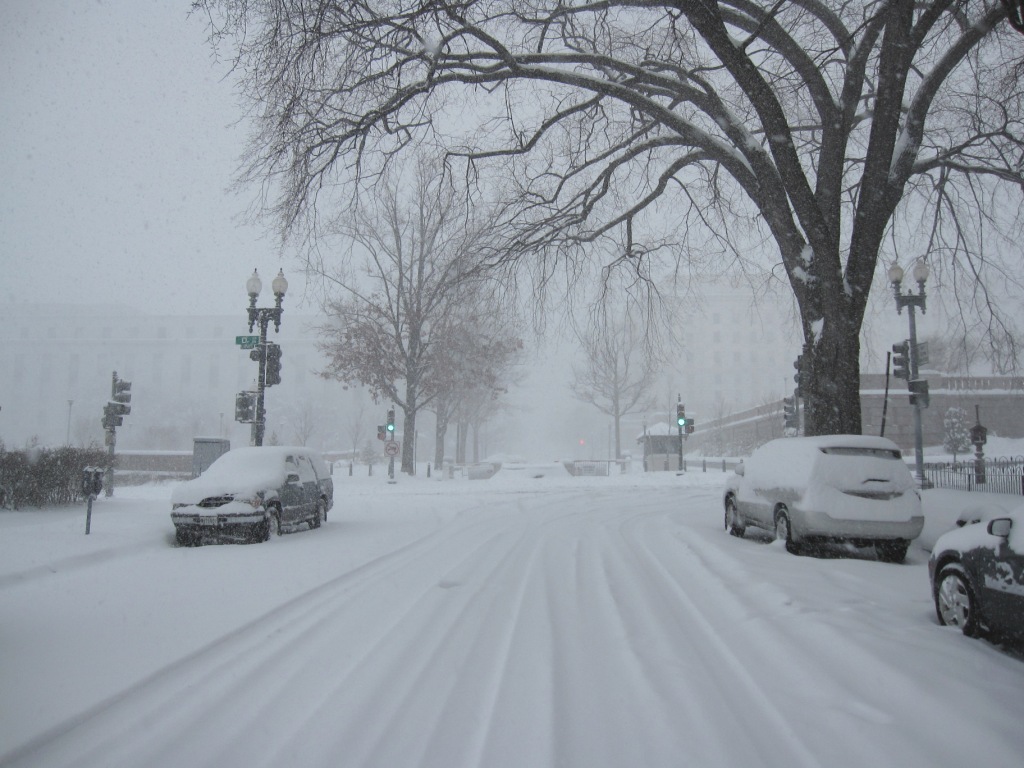
I get it.  30+" of snow is *not* something everybody likes to experience...especially at the expense of losing electricity and heat.  What are people in this predicament supposed to do for a weekend or -- if they're "really unlucky" -- a week of no internet and no warm, cozy homey feeling?

It bothers me to see all of those Pepco numbers and whatnot on the news, seeing how many thousands of people are without power.  It bothers me *more* to know that there are people in the world who don't have those luxuries normally and it never shows up on the news.  People here complain to no end about how they are missing this and needing that, and perhaps after a few phone calls, the repair truck drives up the block.  In the midst of all of these hourly news reports, I think people need to take a step back and remember that they *have* a home, that they *have* the resources to be safe and comfortable year-round and save a blizzard or two that might jeopardize a few nights of email-checking or television-watching, they don't stop to appreciate what they *do* have.

The rest of the world is not as lucky to have every amenity at their disposal, and these kinds of events (whether large-scale like the earthquakes in Haiti or smaller-scale, like not having electricity (although, even then, those scales are all relative)) cannot continue to go unacknowledged.  It makes me think of a chilling truth eloquently stated by Joaquin Phoenix in the 2004 movie Hotel Rwanda, which you can watch here (the whole clip is 46 seconds, though the message itself starts at about 30 seconds in).

Wednesday, February 10, 2010

I'm just a little LOST

The survivors of Oceanic Flight 815 have been on the island for maybe 120 days, and Jin (Daniel Dae Kim) has gone from zero English to executing complicated English phrases perfectly. Maybe it's the language teacher in me that recognizes that, but that is just not realistic whatsoever.  Then again, I suppose that's not the first thing that's fictional about that show...

Monday, February 8, 2010

I would give it a Nine

I just finished watching the movie Nine and I can't type nearly as fast as I came up with things to discuss.  Having spent a great portion of my undergraduate career studying Italian film -- including an entire course on Federico Fellini (a good start, but not nearly enough time to capture his full essence) -- the parallels were all too evident in the 2009 movie musical, one that could easily have followed from Fellini's 1963 spectacle, 8 1/2.  I'm not even quite sure where to begin, so I'll go chronologically through the film with my observations.

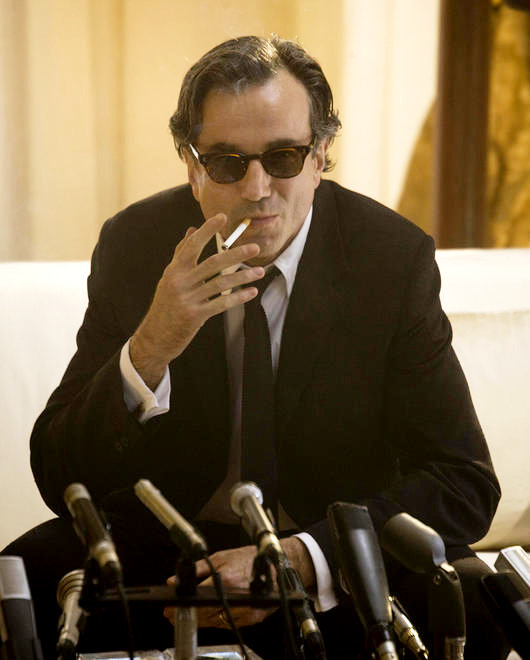
1)  Guido Contini: The name of the main character already comes laden with history, as Guido was also the name of the main character in 8 1/2, famously played by Marcello Mastroianni.  Guido in Nine, however, was brought to you by Daniel Day-Lewis, who actually looked more like Fellini than he did Marcello Mastroianni.  Still, even channeling Fellini gave the film a smooth segue from 8 1/2 to Nine.  Guido, as a character in the former movie, however, has adopted a different last name in this recent version.  The attachment of Contini as the last name may just be a way to reinvent the character, a way to prove that it is *not* the same Guido from before (that, after all, was Guido Anselmi).  But the name Contini brings with it a heavy connection on its shoulders.  In 1977, author Giorgio Bassani wrote a novel called Il Giardino dei Finzi-Contini (The Garden of the Finzi-Continis), a piece that was later turned into a movie of the same name.  The story took place during World War II and told of a Jewish family who tried to maintain their extravagant lifestyle while outside the walls enclosing their estate, Mussolini was imprisoning the Jews.  The wall that created this garden thus offered the Finzi-Contini family protection from the outside world, a way to escape all of the turmoil that they would undoubtedly be exposed to on the other side.  While Nine makes no direct reference to Bassini's work, the name Contini conveys the idea of an inside and an outside, in the same way that it highlights the idea of the spectator and the spectacle.

2) Sophia Loren's role as Mamma in Nine is also extremely telling.  She often starred with Marcello Mastroianni (for example in Una Giornata Particolare (A Special Day) (1974)) and, while Mastroianni himself doesn't appear in Nine, the character he personified in 8 1/2 (Guido) does.  Thus, even though Sophia Loren was not in 8 1/2, her connection to Mastroianni helps her serve as a credible matriarch of Nine, rightly named Mamma.

3) The usage of the number 9 in Nine has two notable meanings that I have found so far.  First, 8 1/2 was Fellini's ninth film.  The fact that this film uses the nearest whole number after 8 1/2 as its title suggests that Fellini's earlier version is now complete.  (Fellini even ends 8 1/2 with a large dance circle, demonstrating not only the importance of grandeur, but also the symbolism embedded in the circle, a representation of the cyclical nature of life and its absurdities.  Even creating this Part Two of 8 1/2 shows that events and people often come full circle.) Second, Guido is 9 years old when he appears in flashbacks.

4) Despite the fact that Nicole Kidman does not play a major role in Nine, she bears a striking resemblance to Anita Ekberg, the Swedish actress who dramatically splashed around in the Trevi Fountain in La Dolce Vita (1960), flirting with Marcello Mastroianni (playing a character named Marcello) and declaring, "Marcello, come here!"  Nine has Kidman occupying a similar role (even with a fountain in the background at one point) with this Guido (not played by Marcello...is this confusing yet?).


5) In Nine, La Saraghina makes her presence known, even if albeit somewhat briefly, and is particularly symbolic of Fellini's work.  She embodies the idea of the spectacle, of the maternal, of dance.   In 8 1/2, Saraghina serves as further personification of the essence of the gaze.  According to Millicent Marcus, a former professor of mine, "Because the dance frees La Saraghina from her role as passive object of the gaze, elevating her to the status of active and emancipated subject, she can, in turn, direct a formative gaze upon the audience of young boys who have served as the enablers in this process of self-idealization" (page 4).  One could actually look upon the ideas of the gaze, the spectacle, and the self throughout both of these films.  Paying attention to each of these elements alone would surely give you a vastly different perspective of the film.  In Nine, Fergie took on the role of La Saraghina as if they shared a bloodline.  A line in 8 1/2 describes her as the devil reincarnate: "Ma non lo sai che La Saraghina e  il diavolo?" ["But you don't know that La Saraghina is the devil?"]  Fergie, in fact, made La Saraghina transition seamlessly from her prior dance on the beach of Rimini in 8 1/2 to her performance later in Nine.  All in all, I'd say a great casting decision.

6) Another throwback to Fellini, Kate Hudson (as Stephanie, a film critic) says, "Every frame is like a postcard."  This one-liner would bring any Fellini fan back to 1952's Lo Sceicco Bianco (The White Sheik), in which the main character, Ivan, brings his virginal bride to Rome for a honeymoon, and while he's sleeping, she goes off in search of the protagonist of her favorite soap opera photo strip.  At her hotel, however, she becomes mesmerized by the postcards at the reception desk, and it is easy to see how much she appreciates these glimpses into other scenes, much like what would appear in the photo strips she adores.

7) Fellini often liked to include a picture within a picture -- or, in other words, people within his broader movie also participating in the watching of a production.  Nine director Rob Marshall preserved this characteristic and had the "inner movie" also titled Nine, thereby making the audience wonder which one was the actual production, the broader story or the story within the story.

8) In Nine, Nicole Kidman's and Daniel Day-Lewis' characters are zooming out of Cinecitta in Day-Lewis' car, reminiscent of a sequence depicted in Fellini's 1972 film Roma [starting in this clip at 2:06].  It could be interpreted in a number of ways (such as a beginning or end of a chapter).  [Something interesting to note is that as they are driving out of Cinecitta to escape the paparazzi, they pass by promotional posters of Australia, Nicole Kidman's 2008 film with Hugh Jackman, clearly having nothing to do with Fellini's work, although a subtlety that Fellini himself may have even opted to include.]

9) At the end of 8 1/2, the audience is given access to the other side of the displays -- the back of the backdrop, if you will -- thus showing that behind every spectacle, there is an extravagant set-up, and that everything is perfectly orchestrated in order to create a final product.  Fellini plays with that idea because he doesn't let his viewers know the difference between the set-up and the product.  Maybe in that way, he makes everything the set-up and everything the product.  In Nine, toward the end of the movie (no spoiler ahead), the audience can see the breakdown of the set in a very similar fashion.

10)  In addition to the aforementioned, Nine pays homage to Fellini in other unobtrusive ways.  While the cameras pan past the outside of Cinecitta (a major film studio in Rome), they show a car pulling up to Soundstage 5.  This soundstage, located on the grounds of Cinecitta, was Fellini's favorite, and was even named in his honor after he died in 1993, adopting the name Teatro Federico Fellini (see page 180 of this book (as well as the other pages, too) for more of the inside scoop).

----------
When I set out to write this blog, I didn't mean for it to come out as a film review.  (If it did, I apologize; I never trust other people's film reviews since everyone has different tastes in movies and also judges them based on varying criteria, so by no means to I wish to impart my own assessment of the movie.)  I just wanted to highlight several items that I noticed and to invite you to comment on other parallels I may not have identified here.  In watching a movie, there is so much more that goes into it than storyline, actors, etc. -- in this case, it was all of this film's intricacies that would go unrecognized by a non-Fellini-phile that, to me, made it a nine.